
The Persona Problem: Why AI's Best Synthetic Populations Still Can't Model How People Actually Think
In October 2025, NVIDIA released Nemotron-Personas-USA — six million fully synthetic American personas, aligned to U.S. Census distributions, generated by the NeMo Data Designer pipeline. By early 2026, the collection had expanded to Japan, India, Singapore, Brazil, France, and South Korea. Millions more synthetic people, each with demographic attributes, personality traits, occupational profiles, and cultural markers. All statistically accurate. All privacy-safe. All completely flat.
This is not a criticism of NVIDIA's engineering. It is a structural observation about what these systems are designed to do — and what they are structurally incapable of doing.
What Distributional Realism Actually Produces
The Nemotron-Personas pipeline, like Tencent's earlier Persona Hub (which scaled to a billion personas from web-crawled data), solves a real problem: generating diverse, census-grounded synthetic records for training and evaluating AI systems. The personas look realistic along every measurable axis — age, geography, education, occupation, Big Five personality traits, cultural background, and interests.
But "realistic along every measurable axis" is not the same as "cognitively valid." These systems extract surface-level correlations from training data and produce what might be called a sophisticated average. They capture what a demographic group is statistically likely to look like. They do not — and cannot — capture the pre-linguistic architecture of how that group protects its certainty under stress.
A Nemotron persona might tell you that a 52-year-old veteran in rural Georgia with a high school education and an extroverted personality profile is likely to hold certain views and exhibit certain behaviors. What it cannot tell you is which of those views function as load-bearing elements of that person's identity — the ones that cannot be traded off without what amounts to a psychological fracture. It cannot tell you which messengers have earned trust and through which channels that trust operates. It cannot distinguish between beliefs held out of conviction and beliefs held because abandoning them would collapse an entire structure of meaning.
That distinction is the entire game.
The Methodological Gap
The core issue is not computational power or dataset size. It is methodological. Current state-of-the-art synthetic persona systems operate top-down: they begin with categories (demographic, geographic, psychographic), then populate those categories with statistically plausible attributes. The output reads like insight. It is actually recombined conventional wisdom, dressed in confident language.
What is missing is a bottom-up cognitive modeling layer — one that starts with the pre-linguistic patterns of thought, feeling, protection, and motivation that are actually active in a specific human terrain, and lets structural groupings emerge from those patterns rather than imposing them from above.
This is not a theoretical nicety. It is the difference between two fundamentally different kinds of output:
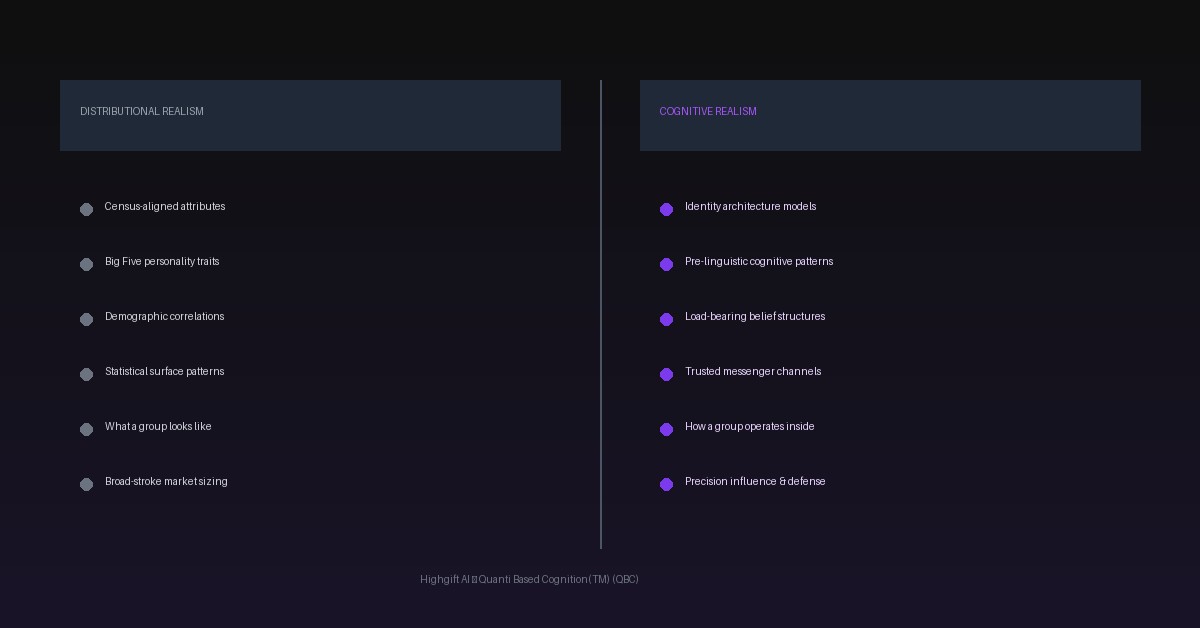
A top-down persona tells you what people in a group are likely to say. A bottom-up cognitive model tells you why they hold the positions they hold, what function those positions serve in their identity architecture, and what would happen if you pushed against them.
The first kind of output is useful for broad-stroke market sizing. The second kind is what you actually need to design communication, policy, or strategy that lands with real humans — because real humans are not statistical averages. They are cognitive configurations, each one managing uncertainty in a specific way.
Why This Matters Beyond Marketing
The practical consequences of this gap range from expensive to dangerous, depending on the domain.
In commercial marketing, the cost is wasted spend. Campaigns designed against flat demographic personas miss the cognitive fault lines that determine whether a message lands, bounces off, or actively backfires. A message that A/B tests well against a composite average can simultaneously alienate three distinct cognitive groups that the average never revealed.
In political campaigns, the cost is strategic blindness. Polling and demographic crosstabs tell you which way a population leans. They do not tell you which voters are in genuine cognitive motion — holding an identity tension that has not yet settled — and which are locked in. Treating both groups identically wastes resources on the unreachable while failing to meet the genuinely persuadable where they actually are.
In national security and cognitive warfare defense, the cost is a critical strategic vulnerability. If the U.S. defense establishment relies on foundation-model-generated "distributional realism" to model adversarial or contested human terrain — to understand how Iranian leadership processes escalation pressure, or how Chinese military elites weigh competing institutional loyalties — it is operating on a model that looks sophisticated and is structurally blind.
Adversaries running cognitive warfare operations are not targeting demographic averages. They are targeting specific cognitive configurations — exploiting sacred values, activating protective responses, and routing influence through trusted channels. Defending against those operations requires the same resolution. A flat synthetic population cannot provide it.
What a Cognitive Architecture Layer Would Require
Building a system that models genuine cognitive configurations rather than statistical composites requires several structural commitments that are absent from current SOTA approaches.
First, the system must model motivation at the level of identity architecture, not attitude. Knowing that someone "distrusts institutions" is a surface-level observation. Understanding that their distrust functions as a protective structure against a felt sense of abandonment by those institutions — and that this protection is bound up with their sense of autonomy, their group allegiances, and their definition of competence — is the level at which influence actually operates.
Second, the system must treat labels as active inputs rather than neutral descriptors. When people label each other — and when researchers label populations — those labels reshape the terrain. A framework that treats "skeptic" or "early adopter" as inert categories, rather than as forces that create normative pressure, will consistently miss how the terrain actually responds to intervention.
Third, the system must model influence as four-dimensional. Message, messenger, timing, and channel interact simultaneously. Optimizing one dimension in isolation — which is what most communication strategy does — produces well-crafted messages that are delivered by the wrong person, through the wrong channel, at the wrong moment. The result is not just failure. It is the kind of failure that looks like you were never paying attention.
Fourth, the system must build bottom-up and validate against contamination. Applying labels before patterns have emerged, then filling in the attributes those labels predict, is the methodological equivalent of writing the conclusion before running the experiment. The output will always confirm the researcher's priors. That is not insight. It is automation of assumption.
Where This Leads
The path forward is not to discard census-grounded population backbones. They serve a real purpose in AI training infrastructure. But they are a foundation layer, not a complete architecture. What is needed on top of that foundation is a cognitive modeling layer that replaces flat narrative generation with structured, deeply human persona architectures — models that capture not just what a population looks like from the outside, but how it operates from the inside.
Whether the application is protecting vulnerable populations from disinformation, designing products that meet people where they actually are, building resilience against adversarial cognitive warfare, or advancing non-profit causes that require genuine persuasion — the gap between distributional realism and cognitive configuration realism is where the consequential work remains to be done.
Highgift AI has built a new AI infrastructure layer called Quanti Based Cognition™ (QBC) to close that gap. Let us know if you need a map of the world you compete in, or would like to join us in helping build them for others.