
October 5, 2026 · 15 min
Why MLB Expansion Should ‘Buscar el Jonrón,’ Not Settle for Singles
Commissioner Rob Manfred knows exactly what the next generation of MLB fans looks like. They’re young, Hispanic, streaming highlights on a phone, and wearing a Francisco Lindor jersey. Every “Baseball Is Something Else” commercial, every TikTok campaign, every international showcase the league runs tells you the same thing: baseball’s future is riding a Latin American/Caribbean wave.
So naturally, Major League Baseball is about to expand into Salt Lake City.
Manfred wants two expansion franchises chosen before he retires in January 2029. The smart money points to Nashville in the East and Salt Lake City in the West. Both are fast-growing markets. Both have ownership groups, stadium plans, and political support. They are, in the language of the industry, "turnkey." And both would be perfectly fine franchises in perfectly fine American cities that would do absolutely nothing to energize or expand the sport’s recent resurgence.
A resurgence driven by consecutive World Series blockbusters, the recent rule changes, and exciting international stars like Ohtani, Tatis, Acuna, Guerrero Jr., and De La Cruz. Stars who are creating cultural momentum … youth-driven momentum … for the first time in decades.
Nashville, Salt Lake, Charlotte, Portland – can you think of any four cities in America that would struggle more to catch a youth-driven, Latin wave?
They are four more English-speaking, small-market, geographically-bounded cities that will attract the same demographic baseball already has. At best, they capture (and to a large extent, cannibalize) a regional audience. They do nothing to excite anyone outside their area codes.
There is one obvious option, however, that does. And almost nobody in the mainstream conversation talks about it seriously.
San Juan: El jonrón evidente
Every time Puerto Rico has appeared on a list of MLB expansion sites, it has been dismissed for the same cluster of reasons: hurricane risk, travel logistics, small island population, political complexity, infrastructure concerns.
Some of these objections are real. But they are also a kind of intellectual laziness — a way of ignoring a harder question:
What if the most valuable thing an expansion franchise can do for MLB isn't fill a stadium in an underserved metro area, but activate an entirely different kind of fan — one who engages not because of where they live, but because of who they are?
While Nashville and Salt Lake City’s addressable markets are the 1-2 million people within driving distance of their ballparks, Puerto Rico's addressable market operates on completely different physics.
There are 3.2 million people on the island — PLUS 5.8 million Puerto Ricans living on the US mainland. And another four million in the broader Caribbean basin with deep baseball cultures and no MLB team to call their own. Not to mention, 62 million Hispanic Americans, many of whom have never had an MLB franchise that felt culturally proximate to their experience.
Puerto Rico is not a geographic market. It is an identity market.
What Criteria Are the Markets Being Judged By?
Major League baseball hasn’t expanded since 1998. That means there’s no modern playbook. But that doesn't mean we're working blind when defining the market variables that are essential for a successful, professional-sports expansion franchise.
What MLB has told us it values (revealed preferences):
- The A's relocation approval tells us the league values tourism-supplemented attendance, small-capacity stadium strategy, private stadium financing, and a market with no existing MLB competition.
- The Rays' long saga (Montreal split-season proposal, Tampa stadium fights) tells us the league won't tolerate public financing uncertainty, split markets, political dysfunction around stadium deals.
- Manfred's public statements have consistently named revenue generation capacity, stadium certainty, and ownership group quality as the three gates.
What the four frontrunner cities have done to position themselves:
- Nashville, Salt Lake City, Charlotte, and Portland have each made public moves — stadium site proposals, ownership group formation, political coalition building. The shape of their bids tells us what they believe MLB is scoring on.
The economics of modern franchise operation:
- Local and regional media rights structures, premium seating revenue models, corporate sponsorship tiers, naming rights markets, and stadium financing mechanisms are well-understood across all major sports. These translate directly.
We can, therefore, derive where the stakeholders that make or break a franchise bid in the current environment come from. They fall into 12 categories:
- Ownership & Capital Depth
- Corporate Sponsorship and Premium Revenue
- Stadium Pathway and Political Environment
- Local Fan Base & Cultural Depth
- External Attendance & Tourism
- Player Attraction, Pipeline, Union Support
- Broadcast, Digital, Media Value
- Gambling & Betting Eco-system
- Competitive Landscape & Market Economics
- Strategic Value to MLB, Owners, Decision-Makers
- Risk, Climate & Infrastructure
- Franchise Narrative & Brand Identity
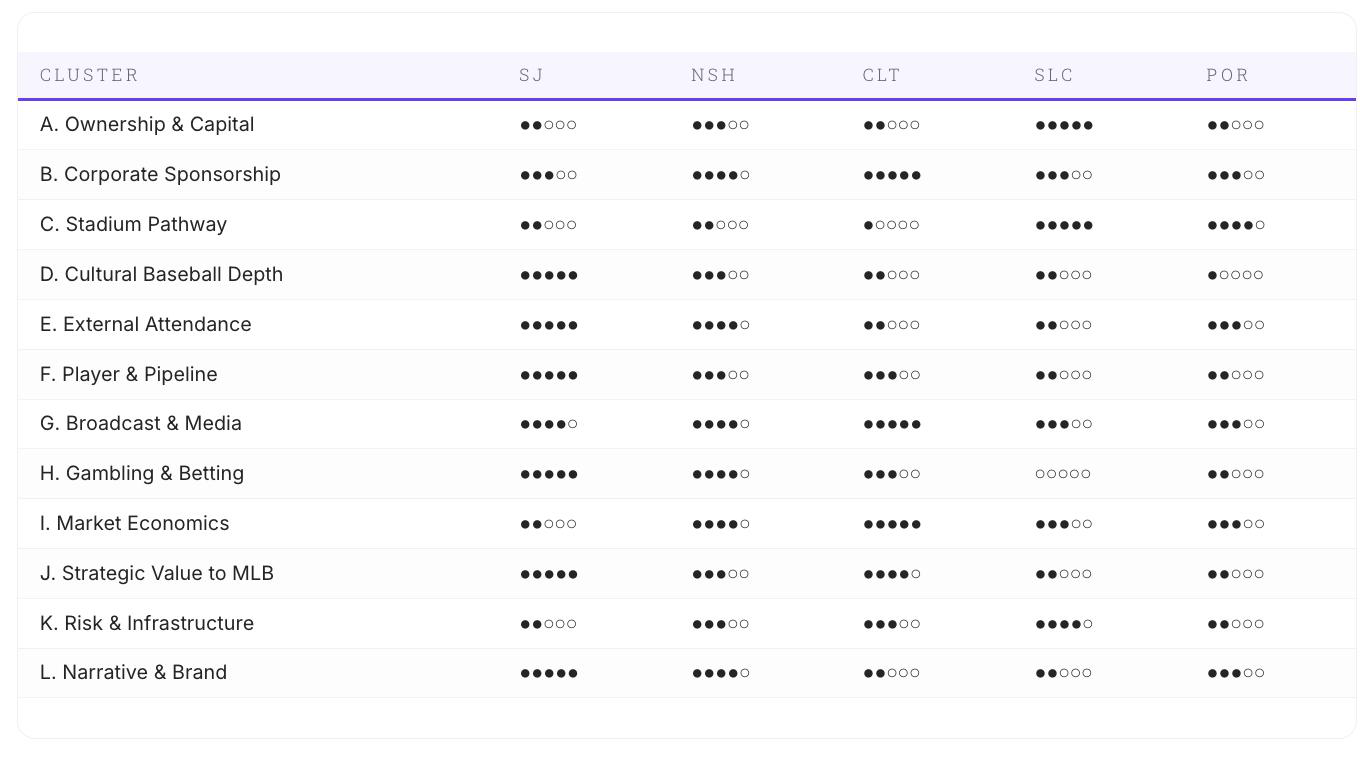
To evaluate the 5 cities objectively – and understand the stakeholders in each category – QBC created a 90-voice franchise viability ecosystem, evaluating twelve structural dimensions that determine whether an expansion franchise can be approved, sustained, and strategically valuable to the league.
The analysis tells a clear story:
- San Juan is the strongest structural candidate. It leads in more clusters than any other city, and its leads are in the dimensions that determine long-term franchise success and strategic value to MLB — cultural depth, fan base authenticity, player attraction, tourism-driven attendance, gambling ecosystem, international growth, demographic alignment, and narrative power.
- Salt Lake City is the strongest process candidate. It leads in the dimensions that determine whether you get approved — ownership readiness, stadium pathway, and risk management.
- Charlotte is the strongest financial candidate. It leads in the dimensions that determine revenue generation — corporate sponsorship, broadcast market, and conventional market economics.
- Nashville is the safest consensus candidate. It doesn't lead anywhere but doesn't have a disqualifying weakness. It's the candidate that generates the fewest objections in a room of 30 risk-averse billionaires.
- Portland is the weakest overall candidate. It has no leading dimension, faces serious structural challenges (income tax, seismic risk, population stagnation, no identified owner), and its strongest asset (state funding) is necessary but not sufficient.
But treating all twelve categories as equally weighted misses the most important finding in this entire analysis:
San Juan is the only candidate whose impact extends beyond its own market and into the structural fabric of every other franchise in the league.
If Nashville gets a franchise, the Yankees are unaffected. The Dodgers don't change. The sport doesn't shift. MLB gets a 31st revenue line and a new city on the schedule. The league is marginally larger. It is not meaningfully different.
San Juan asks — and answers — a fundamentally different question: "What happens to baseball itself when the region that helped build the sport finally has a seat at the table?"
The answer touches every franchise, every roster, every broadcast deal, and every fan in the sport:
Every MLB Roster Is Affected
Approximately 28% of current MLB players are Latino or Caribbean-born. A franchise in San Juan doesn't just attract those players to one roster — it changes the emotional relationship between every Caribbean-born player and the league they play in. It says: "This sport sees you. Not just your talent — your home." That shift in institutional identity affects free agency psychology, international amateur signing competitiveness, and the pipeline of young Caribbean athletes choosing baseball over soccer, basketball, or simply walking away from sports. Every MLB franchise that benefits from Caribbean talent — which is every MLB franchise — benefits from a league that has formally and permanently invested in the Caribbean.
Every MLB Broadcast Is Affected
A San Juan franchise doesn't just add one local media deal. It adds an international broadcast footprint that touches the Dominican Republic, Venezuela, Colombia, Panama, and the broader Caribbean basin. It adds a national Hispanic audience anchored by 5.8 million mainland Puerto Ricans in New York, Orlando, Philadelphia, and Chicago. It adds destination broadcast content — games played in a Caribbean setting with an atmosphere unlike anything else in the sport — that streaming platforms would promote as premium inventory. When MLB renegotiates its next national media deal, the existence of a San Juan franchise makes the entire package more valuable to partners trying to reach younger, more diverse, more international audiences. Every franchise's revenue sharing check from national media reflects that incremental value.
Every MLB Owner's Asset Appreciates
MLB franchise valuations are driven by league-level revenue growth. The dimensions where San Juan leads — international expansion, demographic alignment with the fastest-growing U.S. population segment, gambling ecosystem, tourism-driven premium experiences — are the growth vectors of professional sports economics for the next three decades. A league that can credibly market itself as a hemispheric sport, that has authentic connection to Latino/Hispanic audiences, and that offers destination baseball experiences is a more valuable league than one that added its 31st and 32nd mid-size American cities.
Every Fan's Experience Is Enriched
The San Juan series becomes the most coveted road trip in baseball. Not just for Puerto Rican fans — for every fan. The Yankees fan who follows the team to San Juan for a weekend. The Cubs fan who plans a Caribbean vacation around a series. The baseball purist who wants to experience the sport in a place where it's been loved for 128 years, where the crowd knows every nuance of the game, where the atmosphere is unlike any other stadium in North America. That experience doesn't exist in Salt Lake or Charlotte. It doesn't exist anywhere in the current MLB footprint. It's a new product — destination baseball at a level the sport has never offered.
The Sport's Identity Shifts
This is the deepest level, and the one hardest to put on a spreadsheet. Baseball has a demographic problem. Its audience is aging. Its cultural relevance among young Americans — particularly young Americans of color — is declining relative to basketball, football, and soccer. MLB has spent millions on marketing campaigns, youth initiatives, and rule changes trying to reverse this trend. A franchise in San Juan does something no marketing campaign can: it makes baseball visibly, permanently, structurally the sport of the Caribbean, the sport of Latin America, the sport of the fastest-growing demographic in the United States.
That identity shift helps every franchise trying to sell tickets to the 62 million Hispanic Americans who represent the future of the U.S. consumer market. It helps every franchise trying to sign the next generation of Caribbean talent. It helps every franchise trying to convince a 12-year-old in the Bronx or Orlando or Houston that baseball is their sport, not their grandfather's sport.
If the Vegas Argument Works, the San Juan Argument Is Aces
MLB approved the Oakland A's move to Las Vegas on a core thesis: tourism-driven attendance can supplement a local fan base to fill a stadium. That thesis was built on projections of 9,000 tourists per game, a 70/30 local-to-visitor split, and 2.6 million annual ballpark visitors.
Now apply that same logic to San Juan.
The A's projected 762,000 out-of-town visitors annually to their ballpark, drawn from Vegas's 41.7 million annual visitors. Puerto Rico welcomed 8 million visitors in 2024. That's obviously a smaller top-line, but consider the composition:
- Vegas visitors come for 48-hour casino weekends. A Friday night baseball game competes with Cirque du Soleil, the Sphere, and a poker table.
- San Juan visitors come for multi-day vacations and port calls. A baseball game isn't competing with a slot machine — it's the highlight of the trip. It's the story you tell when you get home.
- Energy-wise, venue-wise, a baseball game in Vegas is no different than a baseball game anywhere else in the US. However, the energy, the passion, and the experience of seeing a baseball game in San Juan will be unlike baseball anywhere else in the league.
If Vegas won the A’s with a pitch that said, "People will travel to see their team play in Vegas because it only happens occasionally," now imagine that same sentence, but instead of a desert casino corridor, you're offering fans a Caribbean island with beaches, rum, and 85-degree weather in April.
But here's where the parallel to Vegas stops being close: baseball is the cultural bloodstream of Puerto Rico. Vegas has zero professional baseball tradition.
MLB has hosted 40+ regular-season games in San Juan over the years. The World Baseball Classic has packed Hiram Bithorn Stadium with passionate, knowledgeable fans who understand the game at a level most American markets can't match. Puerto Rico has a professional winter league dating to 1938, six active teams, a stadium already named after a Major Leaguer (Hiram Bithorn), and a lineage that runs from Clemente to Cepeda to Pudge to Lindor.
MLB already knows this market works. They've tested it repeatedly. Vegas is an experiment. San Juan is a proven concept.
The Objections, Honestly
The operational concerns are real and deserve honest engagement, not dismissal.
Hurricanes: Yes. Puerto Rico is in the hurricane belt. So are Miami, Houston, and Tampa. It’s a risk that requires engineered, established solutions: a hardened or retractable-roof stadium, comprehensive contingency protocols, schedule flexibility.
Travel: San Juan to Miami is 1,045 miles — shorter than Seattle to Anaheim. An East Coast or Southeast division alignment puts San Juan within reasonable flight distance of most opponents. The logistics are more complex than Nashville, but they're not unprecedented.
Stadium financing: Puerto Rico's fiscal situation, post-PROMESA, makes public financing politically fraught. Any deal must be transparent, independently audited, and structured with community benefit agreements that have enforcement mechanisms. The island's economists — who've watched every megaproject promise evaporate — will scrutinize every dollar. This is actually healthy. It forces a better deal than the sweetheart stadium scams that have plagued mainland cities for decades.
Given those Objections, Wouldn’t Mexico City Be a Smarter Move?
For two decades, commissioners have floated Mexico City as baseball's Latin American beachhead. Manfred himself has called it a priority. The logic seems obvious — 22 million people, a passionate sports culture, geographic proximity, and the symbolic power of MLB planting a flag in Latin America's largest city.
But every time the league looks closely, the same barriers appear. Mexico operates in pesos, not dollars — and the peso's volatility against the dollar creates financial planning nightmares for player contracts, stadium financing, and revenue projections. Mexican labor law doesn't map cleanly onto the MLBPA's collective bargaining framework. Mexico City sits at 7,350 feet above sea level — higher than Denver — which would create extreme home-run inflation and distort competitive balance. And perhaps most fundamentally, baseball is not Mexico City's sport. Soccer is. Boxing is. Baseball is a regional passion in Sonora and Sinaloa, not a metropolitan obsession in the capital.
Puerto Rico is, quite literally, the international expansion MLB has been trying to make work for decades — already solved. US dollars. US law. US labor protections. Sea level. A culture where baseball is the national sport, not the third or fourth option. And a location that's closer to Miami than Mexico City is, with direct flights from every major East Coast hub. The question isn't why Puerto Rico instead of Mexico City. The question is why anyone is still talking about Mexico City at all.
The Financial Argument Even John Fisher Would Understand
There's one more dimension of the Puerto Rico case that has received almost no attention in the sports media — Under Puerto Rico's Act 60, the Incentives Code enacted to attract investment to the island — qualifying businesses pay a 4% corporate tax rate on eligible income.
Individual investors who establish Puerto Rico residency can pay 0% on capital gains under existing decrees. Dividends from Act 60-eligible businesses can be received tax-free. All of this is entirely legal under US tax law, a structural feature of Puerto Rico's territorial status that Congress has repeatedly affirmed.
For a prospective MLB ownership group, the implications are staggering.
A franchise owner based in California faces a combined federal and state tax burden that can exceed 50% on income and capital gains. The same owner, establishing residency in Puerto Rico under Act 60, could reduce that burden to 4% on corporate income and potentially 0% on capital gains.
That doesn’t mean Puerto Rico needs to use tax incentives to attract an off-island ownership group. Act 60 has turned Puerto Rico into a magnet for hedge fund managers, private equity operators, and crypto wealth — hundreds of high-net-worth individuals who relocated for the tax structure and now need exactly the kind of social infrastructure a major league franchise provides. These aren't tourists. They're residents writing checks.
Then add 400+ Puerto Rican-born MLB alumni to the ownership bench. The emotional capital and financial capacity for a Caribbean ownership consortium is unmatched in any expansion conversation.
Play, play, play for the home team
When MLB evaluates Nashville or Salt Lake City, it’s asking only one question: "Can this city support a baseball team?" It never asks the far more interesting question: "Can baseball justify having no team in the region that grows its product?"
On Opening Day 2024, 216 players on MLB rosters were born in the Caribbean basin — the Dominican Republic, Venezuela, Cuba, Puerto Rico, Panama, Curaçao, Colombia, Nicaragua. That's nearly one in four major leaguers.
The Dominican Republic alone produces more MLB players than any US state except California and Florida. Puerto Rico has produced Hall of Famers across every era of the sport, from Roberto Clemente to Iván Rodríguez to Roberto Alomar. The Caribbean didn't adopt baseball. It co-authored baseball.
Imagine the appeal of a Caribbean-based team to Caribbean-born free agents. Imagine the emotional and financial calculus: a $30 million annual salary taxed in New York versus 4% in Puerto Rico – playing “at home” represents a difference of millions per year in take-home pay.
The question of which market is a "baseball city" answers itself — if you're willing to measure baseball culture by what a place has given to the sport rather than by what the sport might extract from it.
What MLB Actually Needs
Let us state the strategic argument as plainly as we can.
MLB's existential, future-facing challenge is not stadium capacity. It is cultural relevance. The sport is aging, whitening, and losing ground among younger, more diverse audiences. Every domestic expansion city addresses the capacity question. None of them address the relevance question.
A San Juan franchise tells the world — and more importantly, tells the 62 million Hispanic Americans, the entire Caribbean basin, and every young person deciding whether baseball matters — that MLB is not a nostalgic American institution calcifying in suburban stadiums.
It is a living, evolving, culturally diverse sport that belongs to the people who built it. Roberto Clemente. Orlando Cepeda. Roberto Alomar. Iván Rodríguez. Carlos Beltrán. Francisco Lindor. These men didn't just play baseball. They are baseball. And they've never had an MLB home in the region that produced them.
The strongest expansion slate isn't Puerto Rico instead of Nashville. It's Puerto Rico and Nashville — one conventional domestic market and one transformative identity market, demonstrating that MLB can grow both safely and boldly. But if the Commissioner's Office looks at the long arc of the sport's future — at the demographic reality of an America that is younger, more diverse, more Hispanic, more global every year — and asks which expansion option positions baseball for that future rather than optimizing for the present, the answer is unambiguous.
Nashville is a good investment. Puerto Rico is a transformation.
The question is whether MLB has the institutional courage to choose transformation over comfort. Based on twenty-seven years of choosing comfort, I wouldn't bet on it. But I'd argue for it — because the sport I love is running out of time to become what it needs to be, and there is no Nashville on earth that can make it happen.